
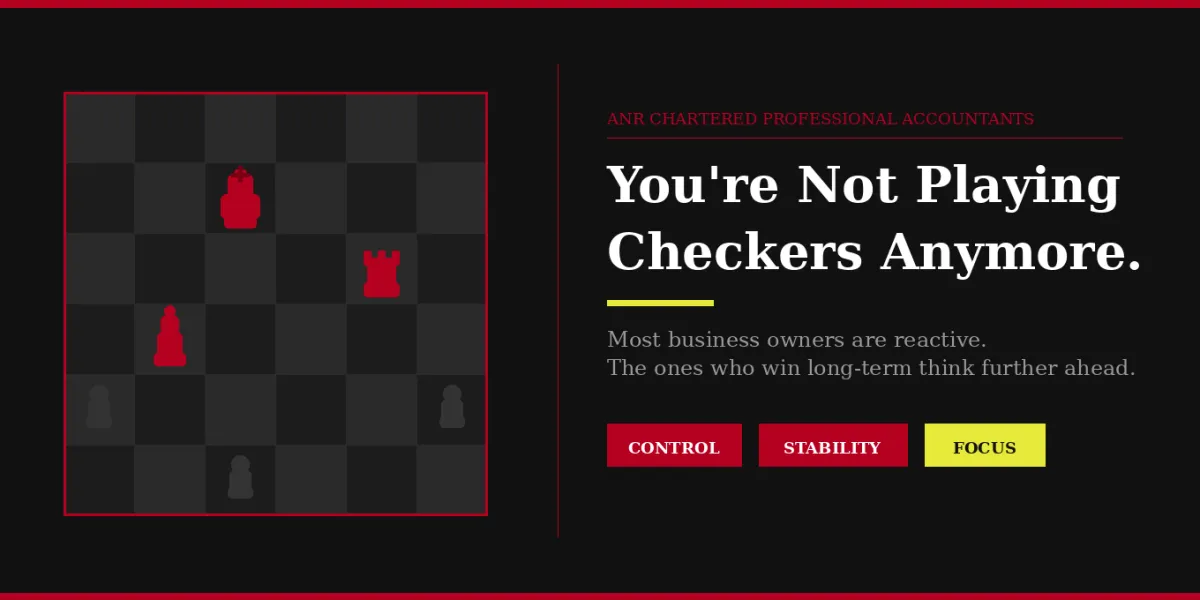
You're Not Playing Checkers Anymore
You're Not Playing Checkers Anymore
Danny turned 59 on a Tuesday. By Wednesday he was back on the job site.
That's who Danny is. Thirty years running an electrical contracting business in Fredericton. Twelve trucks. Twenty-six employees. A reputation built so carefully, so consistently, that new clients still came through word of mouth, the way they always had.
Danny was proud of that. He should have been.
But somewhere between the early morning site visits and the late invoice approvals, a quiet crisis had been building. Not in the business. Underneath it.
He'd been telling his family for years, five more years, then I'm done. Five became four. Four became three. Then he turned 59 and realized, for the first time with real clarity, that he had absolutely no idea what done actually looked like. Not the number. Not the buyer. Not the structure. Not the plan.
Just the wish.
When we sat down with Danny, what we found wasn't unusual but it was serious. No buy-sell agreement. No documented valuation. A corporate structure that hadn't been touched since the early 2000s. His personal estate plan was a folder his lawyer had drafted a decade ago and never updated. And his key foreman, the man who knew every client, every system, every crew had no ownership stake, no retention agreement, and had been quietly fielding calls from a competitor in Moncton for the better part of a year.
Danny's retirement plan, if you could call it that, was four words: whatever the business is worth.
He wasn't reckless. He wasn't irresponsible. He was just doing what most owners do, keeping his head down, keeping the trucks moving, keeping his people paid. He was extraordinary at the day-to-day. Nobody had ever asked him to look up.
Nobody had ever helped him see that he wasn't just running a business anymore. He was sitting at a chess board, playing checkers, with the clock running out.
The Game Most Owners Are Actually Playing
Checkers is a good game. Fast. Instinctive. Reactive. You see a threat, you respond. You move, they move, you adapt. For a long time, especially in the early years of building a business, that skillset is exactly what you need.
The problem is that most owners never get the memo that the game changed.
At some point and it's different for everyone, the business becomes complex enough, valuable enough, and consequential enough that reactive decision-making starts working against you. The moves that built the business aren't the moves that protect it. The instincts that got you here aren't the instincts that get you out well.
Checkers rewards the person who reacts fastest. Chess rewards the person who thinks furthest ahead.
In chess, every piece has a role. Every move has consequences that echo forward, three moves, five moves, eight moves down the board. The players who win aren't the most aggressive or the most cautious. They're the ones who've already played the next chapter in their head before anyone else at the table has seen it coming.
Owning a business is chess. It always has been. Most owners just don't find that out until a move they made years ago finally catches up with them.
Checkers Players React. Chess Players Anticipate.
Here's the hard truth about Danny's situation and about a lot of owners we meet: the threat was never hidden. It was just never named.
The foreman who might walk. The structure that hadn't kept pace with the growth. The exit that existed only as a vague intention. These weren't surprises waiting to happen. They were known unknowns that had never been forced into a conversation.
That's the real cost of reactive ownership. Not one catastrophic mistake — but the slow accumulation of unexamined moves. Decisions deferred. Structures ignored. Conversations avoided because there was always something more urgent on the job site.
Chess players don't manage threats. They architect positions that make threats irrelevant before they materialize. They ask not what's on fire today but what do I need to be true in five years, and what has to happen now to get there.
That's a different question. It requires a different kind of thinking. And for most owners, it requires someone who can look at the board from outside the game.
The Board Has Three Sections
At ANR, we think about every business owner's situation through the Control–Stability–Focus Framework. Three dimensions. One sequence. And the sequence matters enormously.
Control comes first. Not confidence, actual control. Clean corporate structures. Agreements that reflect reality. Legal and financial architecture that holds up under pressure. Danny believed he had control of his business. In practice, one foreman's resignation letter could have triggered a client exodus, a crew collapse, and a valuation that bore no resemblance to what he thought he'd built.
Stability comes second. Personal stability. Estate stability. A structure that ensures the wealth created inside the business can actually reach the owner and their family when it matters most. For a business owner in their late fifties, this isn't theoretical, it's everything. Stability is the floor. Without it, one bad year, one health event, one unforeseen departure doesn't just hurt. It can erase decades.
Focus comes third. This is where exit strategy lives. Succession planning. Enterprise value. The deliberate, compounding decisions that turn a well-run business into a transferable asset. Focus is where most owners want to start, it's the exciting part, the growth part, the endgame part. But Focus without Control and Stability underneath it isn't strategy. It's optimism on a cracked foundation.
Build in sequence. That's the game.
What a Good Coach Sees
Even grandmasters have coaches. Not because they can't read the board, they see it better than almost anyone alive. But because the hardest thing in chess, and in business, is seeing your own position clearly from inside it.
You know your trade. You know your clients. You know your people. That knowledge is irreplaceable and it's the reason you've made it this far. But the questions that will determine whether the wealth you've built actually reaches you: the structural questions, the tax questions, the succession questions, the ones that live underneath the daily operation, those are genuinely difficult to see from where you're standing.
A real advisory relationship doesn't just file the returns and send the invoice. It looks at your board and tells you what it sees. The exposed pieces. The missed moves. The positions you've drifted into without realizing it. And then it helps you build forward, deliberately, toward an endgame that actually reflects what you've worked for.
Danny is still in the game. The structures are being rebuilt. The conversations that should have happened years ago are happening now. The foreman has a retention plan. The exit has a number, a timeline, and a pathway.
For the first time in years, Danny can see the end of the board and he's playing toward it on purpose.
That's what changes when you start playing chess.
Are You Playing the Right Game?
If you've spent decades building something real, you deserve more than a vague plan and a hope that it all works out.
The ANR team works with owner-managed businesses across Atlantic Canada, at every stage, and especially the ones where the stakes are highest. If you've never had someone sit down with you and honestly look at the board, that conversation might be worth having.
The game is chess. Let's make sure you're playing it that way.


